


Sustainability management
– Strategic integration: Sustainability priorities are embedded into LTOU’s strategic operational plan and core corporate documents.
– Performance monitoring: We continuously track sustainability performance indicators in line with ETAS requirements and publish an annual Sustainability Report.
– Impact and compliance assessments: We regularly assess our environmental, economic, and social impacts, conduct Double Materiality and Climate Risk Assessments, and review compliance with the EU Taxonomy. Based on these insights, priority sustainability topics are updated.
– Transparent communication: We ensure consistent sustainability communication both externally—engaging with stakeholders—and internally across the organization.
Clear sustainability roles and responsibilities are established to support integrated implementation and accountability.
Sustainability Function Responsibilities
Sustainability Policies
Sustainability areas and topics
Sustainability at the company is developed as an integral part of all activities and is oriented toward three key sustainability pillars – Environmental (E), Social (S), and Governance (G).
Based on the results of the Double Materiality Assessment carried out in the company in 2025, the key impact‑, risk‑, and opportunity‑related sustainability topics for this period have been identified within the sustainability pillars.
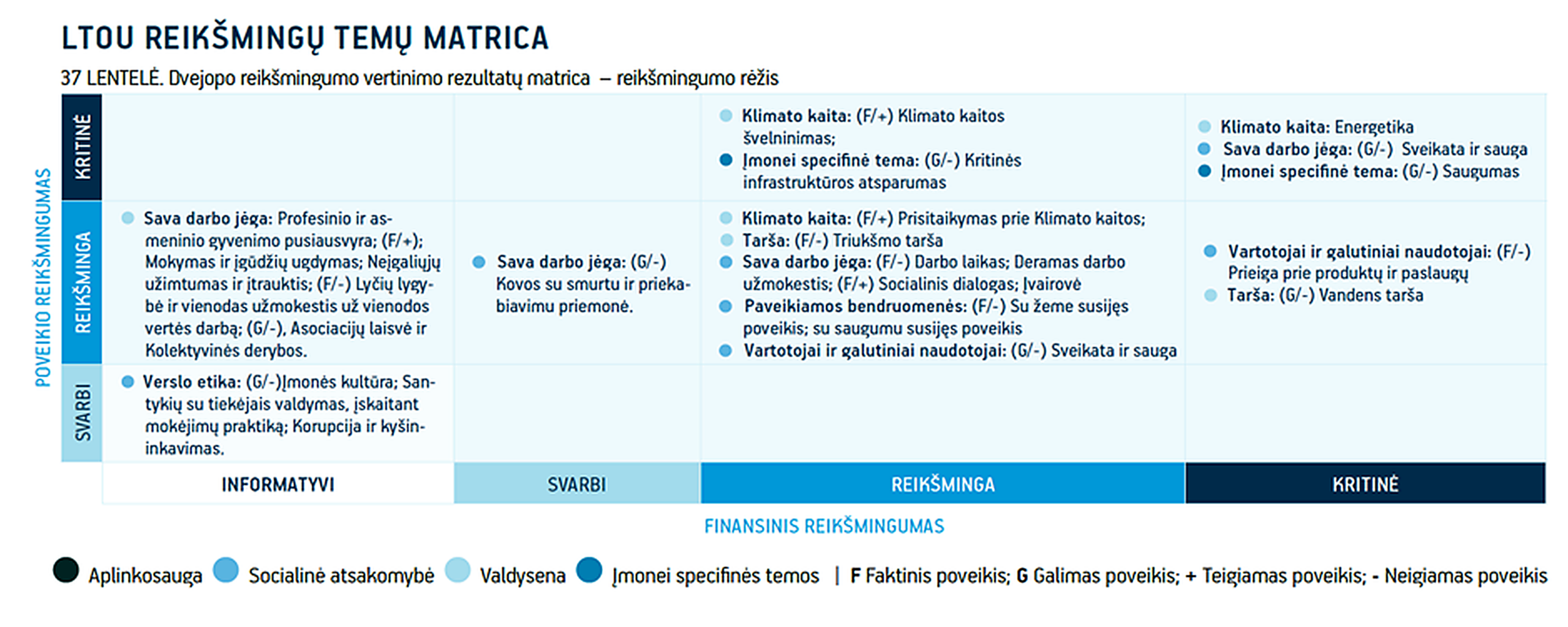
We aim to maintain a balanced approach by considering the impact of aircraft noise and assessing the quality of life of residents living near airports. Our goal is to protect local communities from the negative effects of aviation noise while ensuring sustainable development and supporting the growth of the aviation sector.
We are committed to sustainable development that takes into account community well‑being and safeguards people from noise exposure.
The main objective of noise management is to ensure that—despite the increasing number of flights—the high‑noise exposure zones do not expand or decrease, along with the number of residents affected by excessive noise.
We implement measures to continuously monitor, control, and manage noise generated by airport operations.
Sustainability goals
Information under preparation.
Sustainability projects and initiatives
ALIGHT
From 2020 to 2025, Vilnius Airport, together with 13 international partners — including Copenhagen Airport, Rome Airport, SAS, IATA, and others — participated in the ALIGHT project funded by the EU Horizon 2020 Smart Airports research and innovation programme.
The aim of the project was to demonstrate how future airport infrastructure should be designed to reduce and ultimately eliminate CO₂ emissions. Project activities focused on identifying solutions for the successful implementation of sustainable aviation fuel (SAF) supply, as well as developing smart airport systems such as renewable energy integration, energy storage, energy management, electrification, and other sustainability measures.
More information about the ALIGHT project is available here:
https://www.alight-aviation.eu/
BSR HyAirport
Since 2024, Lithuanian Airports have officially joined an international project focused on developing innovative hydrogen solutions for the aviation sector. The BSR HyAirport project aims to identify practical solutions for adapting airport infrastructure to future hydrogen‑powered aircraft, using hydrogen as an alternative fuel for airport ground support equipment, and preparing airports to store, process, and supply green hydrogen as a future aviation energy source.
The total project budget is EUR 4.8 million, part of which is allocated to activities coordinated by experts from Lithuanian Airports. More than 40 organizations are involved in the project, including airports from the Baltic Sea Region, technology companies, and scientific research institutions.
The project will create a unique platform for jointly developing, implementing, and testing practical solutions to address shared challenges and the specific needs of hydrogen‑powered aviation.
The project was launched at the end of 2023 and will continue until the end of 2026.
More information: https://interreg-baltic.eu/project/bsr-hyairport/
Sustainability reporting
Aerodrome Noise Protection Zones
Compensation application form
Please send the completed compensation application form by email to [email protected]
NPZ maps
Compensation maps
Key legal acts
Published documents
Information for land plot owners, natural persons using land under a contract registered in the Real Property Register, as well as those whose place of residence is unknown or who could not be reached by registered mail.
Joint-stock company Lithuanian Airports (hereinafter – LTOU) hereby informs about the strategic noise maps for Vilnius, Kaunas and Palanga civil aerodromes approved by the Order of the Minister of Transport and Communications of the Republic of Lithuania No. 3‑69 of 28 February 2024 “On the Approval of Strategic Noise Maps for Vilnius, Kaunas and Palanga Civil Aerodromes for Establishing Noise Protection Zones” (hereinafter – TAZ Maps). These maps form the basis for establishing noise protection zones (hereinafter – TAZ) around Vilnius, Kaunas and Palanga civil aerodromes.
The purpose of preparing the TAZ Maps is to comply with the requirements set out in Article 3, Article 6(1)(6), Article 7(3)(4), Articles 54 and 55 of the Law on Special Land Use Conditions of the Republic of Lithuania (hereinafter – the SŽNSĮ), Article 13(2) of the Aviation Law, and points 10 and 12 of the Rules for Preparing, Coordinating, Approving, Publishing Strategic Noise Maps and Reimbursing the Costs of Noise Reduction Measures, approved by Government Resolution No. 1369 of 2 December 2020.
Special Land Use Conditions in Aerodrome Noise Protection Zones
According to Article 55 of the SŽNSĮ, the following activities are prohibited within aerodrome TAZ:
- construction of residential, recreational, healthcare buildings; general education, vocational, higher education institutions, kindergartens and nursery buildings; science and research buildings intended for formal or non-formal education; recreational or healthcare buildings;
- installation of the above‑mentioned types of premises in buildings of other designated uses, including through reconstruction or repair;
- changing the use of buildings or premises to any of the above‑mentioned purposes;
- Planning areas for recreational developments intended for the uses listed above, except when such developments are intended exclusively for the needs of the aerodrome operator and/or airport‑related activities.
Reconstruction of residential buildings is prohibited if such reconstruction increases the external dimensions of the building.
Right to Apply for Compensation
Following Article 11(3) and 11(4) of the SŽNSĮ, LTOU also informs land plot owners, persons whose rights to the land are registered in the Real Property Register, and persons whose place of residence is unknown or who could not be reached by registered mail, of their right to apply to LTOU for reimbursement of the costs of implementing noise‑reduction measures within designated aerodrome TAZ.
These compensations may be paid based on the 2023 Compensation Maps, approved by Order No. 3‑68 of the Minister of Transport and Communications of 28 February 2024, for buildings (premises) listed in Article 14(2) of the Aviation Law that fall within TAZ I, II or III zones as defined in the 2023 Compensation Maps.
Land plots (or their parts) located within the designated TAZ in Vilnius City Municipality, Kaunas District Municipality, Jonava District Municipality and Palanga City Municipality, where the owners or users under registered agreements could not be contacted, are published on the LTOU website under the Sustainability section.
Access to Approved Maps
The approved TAZ Maps (publicly available since 27 December 2023), indicating the list of land plots (or their parts) falling within the TAZ territories, are available on the LTOU website under the Sustainability section.
The approved 2023 Compensation Maps, indicating buildings (premises) belonging to owners or trustees eligible for compensation within TAZ I, II and III areas, are also available on the LTOU website under the Sustainability section.
Map Preparation and Contact Information
The TAZ Maps and 2023 Compensation Maps were prepared by:
Lithuanian Airports, legal entity code 120864074, Rodūnios kelias 10A, 02189 Vilnius, tel. +370 5 273 9326, e‑mail: [email protected].
The person responsible for the preparation of TAZ Maps and 2023 Compensation Maps:
Aldona Jokubauskienė, Environmental Projects Manager, tel. +370 669 39454, e‑mail: [email protected].
For information regarding TAZ Maps, 2023 Compensation Maps, or related queries, please contact: Aldona Jokubauskienė, Environmental Projects Manager, tel. +370 669 39454, e‑mail: [email protected].
List of Land Plots Included in the Strategic Noise Maps
List of land plots (or their parts) located within the noise protection zones established by the Strategic Noise Maps, whose owners or land users under registered agreements have unknown addresses or could not be reached by registered mail, is published below.
Abbreviations
- STRATEGIC NOISE MAPS – noise maps prepared through modelling, used as the basis for establishing Noise Protection Zones (TAZ) around Vilnius, Kaunas, and Palanga airports.
- RULES – the rules for preparing, coordinating, approving, publishing strategic noise maps, and compensating the costs of implementing noise‑reduction measures (Regulation No. 1369).
- SAZ – sanitary protection zone.
- SŽNS – special land use conditions.
- TAZ – noise protection zones.
CO2 Emissions at Lithuanian Airports
Vilnius Airport
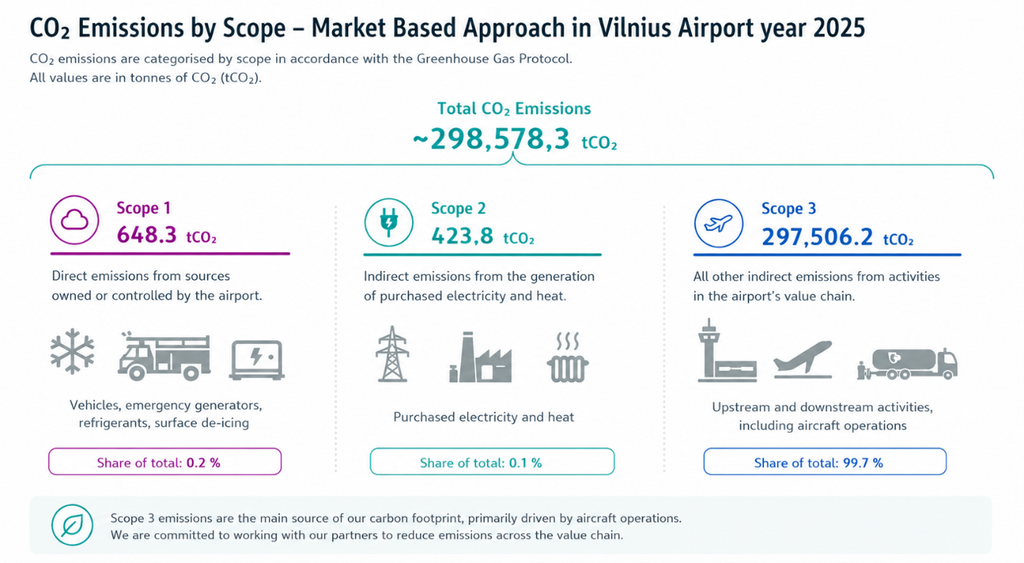
The ACI Airport Carbon Accreditation program follows accepted Greenhouse Gas Protocol standards for the organizational reporting of CO2 gas emissions. As such Scope 1 emissions are those emissions for which the reporting entity (in this case VNO) has direct operational control or ownership. Scope 2 emissions are those associated with the purchase of electrical and heat energy from grid supplies and Scope 3 emissions are those associated with supply chain activities, over which the reporting entity has no direct operational control or ownership, but over which they may exert some influence.
Emissions boundaries for the VNO have been identified appropriately as required by the ACI scheme and as outlined by the Green House Gas Protocol.
SCOPE 1 emissions are defined as direct CO2 emissions arising from sources that are owned or controlled by the company. The emissions result from activities that Vilnius Airport can have direct influence on through its actions are:
- Mobile sources (solid, liquid, and gaseous fuels for vehicles and machinery (air-/landside))
- Stationary sources (emergency generators, fire training (incl. handheld extinguishers))
- Process (refrigerant losses from air-conditioning units (not stock volume), fugitive emissions from de-icing chemicals)
SCOPE 2 emissions are associated with the use of electricity/heat imported from the grid or from a third-party supplier of energy in the form of heat or electricity. These indirect CO2 emissions are due to upstream emissions from the production and delivery of fuel to power stations. Vilnius Airport can influence the amount of electricity and heat power it uses; however, it has little control over the generation of the electricity/heat:
- Emissions from purchased grid electricity
- Emissions from purchased heat
- Emissions from purchased grid electricity for off-site use
SCOPE 3 emissions are defined as those arising as an indirect consequence of the use of goods or services provided by the company. Vilnius Airport do have some influence over Scope 3 emissions, but the activities are not under its control. Sources of Scope 3 emissions arising at Vilnius airport and included into the boundary description are as follows:
- Waste generated in operations (waste and wastewater)
- Airport operator staff business travel
- Employee commuting and home office
- Use of sold products (the airport’s “product sold” is the infrastructure and service (runways, stands, roads, parkings, etc) that third parties can use for the purpose of air travel):
- Aircraft full flight emmisions based on fuel uplift
- Aircraft APU: Auxiliary Power Unit of aircraft
- Aircraft MRO: fuels from engine testing
- Airside GSE activities by third party operators (fuels, deicing, etc.)
- Surface access to the airport (employees and passengers)
- Tenant electricity and heating
For year 2025 all emissions are
Kaunas Airport
The ACI Airport Carbon Accreditation program follows accepted Greenhouse Gas Protocol standards for the organizational reporting of CO2 gas emissions. As such Scope 1 emissions are those emissions for which the reporting entity (in this case KUN) has direct operational control or ownership. Scope 2 emissions are those associated with the purchase of electrical and heat energy from grid supplies and Scope 3 emissions are those associated with supply chain activities, over which the reporting entity has no direct operational control or ownership, but over which they may exert some influence.
Emissions boundaries for the KUN have been identified appropriately as required by the ACI scheme and as outlined by the Green House Gas Protocol.
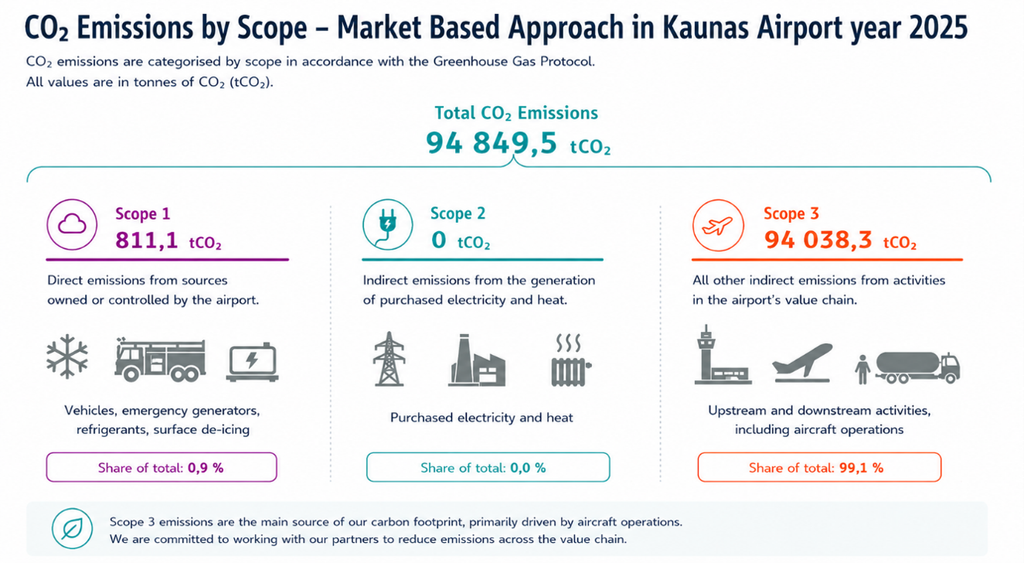
SCOPE 1 emissions are defined as direct CO2 emissions arising from sources that are owned or controlled by the company. The emissions result from activities that Kaunas Airport can have direct influence on through its actions:
- Mobile sources (solid, liquid, and gaseous fuels for vehicles and machinery (air-/landside))
- Stationary sources (solid, liquid, and gaseous fuels for boilers, furnaces, emergency generators, fire training (incl. handheld extinguishers))
- Process (refrigerant losses from air-conditioning units (not stock volume), fugitive emissions from de-icing chemicals)
SCOPE 2 emissions are associated with the use of electricity imported from the grid or from a third-party supplier of energy in the form of electricity. These indirect CO2 emissions are due to upstream emissions from the production and delivery of fuel to power stations. KUN can have influence on the amount of energy it uses; however, it has little control over its generation:
- Emissions from purchased grid electricity
- Emissions from purchased grid electricity for off-site use
SCOPE 3 emissions are defined as those arising as an indirect consequence of the use of goods or services provided by the company. Kaunas Airport do have some influence over Scope 3 emissions, but the activities are not under its control. Sources of Scope 3 emissions arising at Kaunas airport and included into the boundary description are as follows:
- Waste generated in operations (waste and wastewater)
- Airport operator staff business travel
- Employee commuting and home office
- Use of sold products (the airport’s “product sold” is the infrastructure and service (runways, stands, roads, parkings, etc) that third parties can use for the purpose of air travel):
- Aircraft full flight emmisions based on fuel uplift
- Aircraft APU: Auxiliary Power Unit of aircraft
- Aircraft MRO: fuels from engine testing
- Airside GSE activities by third party operators (fuels, deicing, etc.)
- Surface access to the airport (employees and passengers)
- Tenant electricity and heating
Palanga Airport
The ACI Airport Carbon Accreditation program follows accepted Greenhouse Gas Protocol standards for the organizational reporting of CO2 gas emissions. As such Scope 1 emissions are those emissions for which the reporting entity (in this case PLQ) has direct operational control or ownership. Scope 2 emissions are those associated with the purchase of electrical and heat energy from grid supplies and Scope 3 emissions are those associated with supply chain activities, over which the reporting entity has no direct operational control or ownership, but over which they may exert some influence.
Emissions boundaries for the PLQ have been identified appropriately as required by the ACI scheme and as outlined by the Green House Gas Protocol.
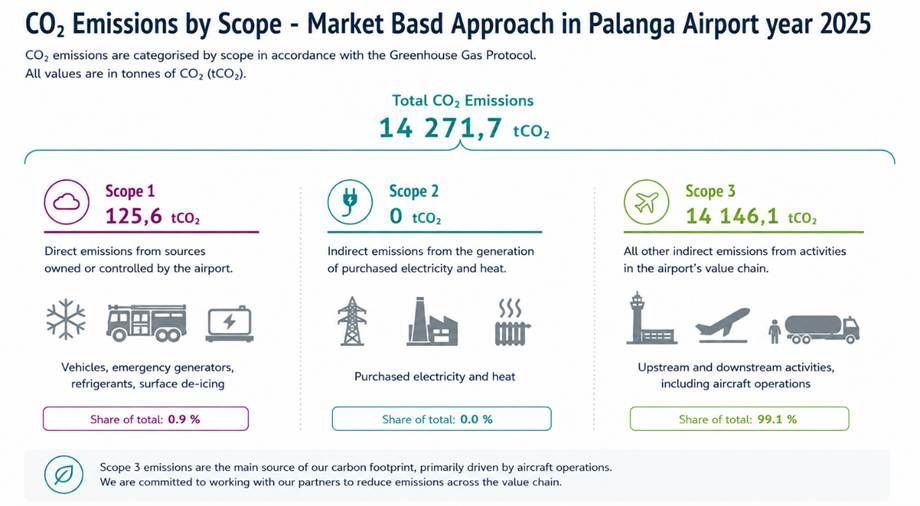
SCOPE 1 emissions are defined as direct CO2 emissions arising from sources that are owned or controlled by the company. The emissions result from activities that Palanga Airport can have direct influence on through its actions:
- Mobile sources (solid, liquid, and gaseous fuels for vehicles and machinery (air-/landside))
- Stationary sources (solid, liquid, and gaseous fuels for boilers, furnaces, emergency generators, fire training (incl. handheld extinguishers))
- Process (refrigerant losses from air-conditioning units (not stock volume), fugitive emissions from de-icing chemicals)
SCOPE 2 emissions are associated with the use of electricity imported from the grid or from a third-party supplier of energy in the form of electricity. These indirect CO2 emissions are due to upstream emissions from the production and delivery of fuel to power stations. PLQ can have influence on the amount of energy it uses; however, it has little control over its generation:
- Emissions from purchased grid electricity
- Emissions from purchased grid electricity for off-site use
SCOPE 3 emissions are defined as those arising as an indirect consequence of the use of goods or services provided by the company. Palanga Airport do have some influence over Scope 3 emissions, but the activities are not under its control. Sources of Scope 3 emissions never been calculated before and year 2025 was first year for this calculation. Calculation for Scope 3 at Palanga airport was included into the boundary description are as follows:
- Waste generated in operations (waste and wastewater)
- Airport operator staff business travel
- Employee commuting and home office
- Use of sold products (the airport’s “product sold” is the infrastructure and service (runways, stands, roads, parkings, etc) that third parties can use for the purpose of air travel):
- Aircraft full flight emmisions based on fuel uplift
- Aircraft APU: Auxiliary Power Unit of aircraft
- Aircraft MRO: fuels from engine testing
- Airside GSE activities by third party operators (fuels, deicing, etc.)
- Surface access to the airport (employees and passengers)
- Tenant electricity and heating
CO2 emissions for the organization for this measurement period (2025) calculated both using Location and Market based approach are provided in Figs 3 and 4 where they are presented by scope, by business unit and as total emissions.
PLQ is using its own generated heat, produced during the combustion of natural gas which is less CO2 emitting comparing to other types of fuel (coal, diesel, gasoline). The results of PLQ CO2 emissions are very different using Location and Market based approach, due to different emission factors. Using Location based approach, the biggest part – 47 % – of the CO2 emissions were due to the purchased electricity, while fuel use in vehicles made 22% of yearly CO2 footprint. Heat production accounts only for 18 % of emissions in Location based approach. Using Market based approach, the biggest part of CO2 emissions was accounted for vehicles – 33 %, while production of heat is accountable for 26 %, and purchased electricity – 22 % of yearly CO2 footprint. The total PLQ CO2 emissions in 2025 were also very different when using Location or Market based approach – respectively 225.1 tCO2e and 129.6 tCO2e.
Graph in Fig. 2 represent PLQ emissions by scope, using Market based approach. Scope 3 sources are responsible for 96 % of total CO2 emissions in 2025. Full break-down of all Scope 1, Scope 2 and Scope 3 emissions is given in the Table 2. Regardless of assessment method, the biggest amount of CO2 emissions is caused by the aircraft activities – Aircraft full flight emissions based on fuel uplift. Scope 3 in PLQ airport 2025 was calculated first time.
FAQ
Why was the regulation of aerodrome Noise Protection Zones (TAZ) initiated?
To protect residents living closest to airports from aircraft‑generated noise
On what basis must aerodromes establish Noise Protection Zones (TAZ)?
The obligation to designate TAZ around civil aerodromes with a paved runway of at least 1,200 meters is established in Article 54 of the Law on Special Land Use Conditions (SŽNSĮ), in force since 1 January 2020. TAZ replaces the previously required Sanitary Protection Zones (SAZ) defined in Article 24 of the Noise Management Law No. IX‑2499. Under the updated regulation, airports must establish TAZ based on actual noise levels.
How do SAZ and TAZ differ?
It is permitted to live in areas where a Noise Protection Zone (TAZ) has been designated and registered, whereas in a Sanitary Protection Zone (SAZ) residential buildings were not allowed.
Who determines aircraft noise‑reduction measures?
According to the Noise Management Law No. IX‑2499, aircraft noise‑reduction measures are set by the Ministry of Transport of the Republic of Lithuania.
Who is responsible for establishing aerodrome TAZ?
For aerodromes with an artificial runway of no less than 1,200 metres, the entity responsible for establishing TAZ is the airport operator.In the case of Vilnius, Kaunas, and Palanga airports, LTOU is responsible for establishing TAZ in accordance with the procedures set out in applicable legal acts. This obligation is defined in the Rules for the Preparation, Coordination, Approval, Publication of Strategic Noise Maps and Reimbursement of Costs for Implementing Noise Reduction Measures (Government Resolution No. 1369).
Which LTOU aerodromes have TAZ established?
Lithuanian Airports: Vilnius, Kaunas, and Palanga.
How are TAZ boundaries determined?
TAZ boundaries are established based on the methodology defined in applicable legal acts.
An aerodrome’s TAZ is determined using a modelled strategic (perspective) noise map when:
- the forecast night‑time noise indicator (Lnight) exceeds 55 dBA, and
- the day‑evening‑night noise indicator (Lden) exceeds 65 dBA
(as specified in Article 13 of the Aviation Law).
The values of the annual noise indicators Lden and Lnight are determined using the methodology described in the European Civil Aviation Conference (ECAC) report ECAC.CEAC Doc. 29 — “Report on Standard Method of Computing Noise Contours around Civil Airports”, Third Edition (7 December 2005).
What methodology is used to prepare strategic (perspective) noise maps?
The procedure for preparing, coordinating, approving and publishing strategic noise maps is defined in the Rules for the Preparation, Coordination, Approval, Publication of Strategic Noise Maps and Reimbursement of Costs for Implementing Noise Reduction Measures, approved by the Government.
Strategic noise maps, which form the basis for establishing TAZ boundaries, are prepared using the following data:
- Registers and state information systems: data from registered information systems and state registers (excluding personal data).
- National spatial data sets and maps: the datasets and maps approved by the Minister of Agriculture of the Republic of Lithuania, including cartographic materials and the latest available spatial data.
- Data on aircraft operations at civil aerodromes: information on historical aircraft movements and noise indicators (day, evening and night), as well as forecasts for the maximum number of aircraft movements (for no less than the next 10 years) according to civil aerodrome master plans or traffic flow forecasts.
- Standard aircraft take‑off and landing trajectories.
- Aircraft types and their emitted noise levels.
- Other data needed for noise modelling, as specified in the Rules and in accordance with the methodology established in Lithuania.
What restrictions does TAZ regulation impose on residents and/or businesses?
Within an aerodrome’s Noise Protection Zone (TAZ), it is prohibited to:
- construct buildings intended for residential, recreational, healthcare, general education, vocational or higher education purposes, childcare facilities, or other educational buildings for formal or non‑formal education; as well as recreational or healthcare buildings;
- establish premises of the above‑listed purposes within buildings of another use, including during reconstruction or renovation;
- change the purpose of buildings or premises to any of the above‑listed purposes;
- plan territories for recreational development requiring construction of the above‑listed buildings, except when such facilities are used solely for the needs of the aerodrome operator and/or activities related to airport operations.
Reconstruction of residential buildings is also prohibited if the reconstruction increases the external dimensions of the building.
Do the restrictions on constructing residential, recreational, healthcare and other similar buildings also apply to projects that obtained building permits before the approval and registration of the strategic noise maps?
If building permits for such constructions were issued before the approval and registration date of the TAZ maps, these construction restrictions do not apply. Special land‑use conditions apply only to activities that were planned and/or initiated after the TAZ maps were approved and registered.
What is allowed for residents and/or businesses within TAZ?
Within an aerodrome TAZ, the construction and reconstruction of buildings for hotel, administrative, commercial, service, transport, industrial, garage, storage, specialized, sports, gardening, auxiliary farm and other non‑residential purposes is permitted. In such cases, TAZ restrictions do not apply.
For which types of buildings can noise‑reduction measures be installed and eligible for compensation?
According to the provisions of the Rules (Clause 18), noise‑reduction measures may be installed in:
- residential buildings,
- recreational buildings,
- healthcare buildings,
- general education, vocational and higher education buildings,
- childcare facilities (kindergartens, nurseries),
- buildings intended for educational purposes,
- and other buildings used for non‑formal education.
These are the building types eligible for compensation.
Which noise‑reduction measures are eligible for compensation?
- In TAZ Zone I, compensation is provided for the purchase and installation of:
• noise‑insulating windows for living rooms, kitchens, dining rooms and bedrooms;
• noise‑insulating roofing or external wall insulation (insulating interior spaces from outdoor noise);
• noise‑insulating ventilation systems.
- In TAZ Zone II, compensation is provided for the purchase and installation of:
• noise‑insulating windows for living rooms, kitchens, dining rooms and bedrooms.
- In TAZ Zone III, compensation is provided for the purchase and installation of:
• noise‑insulating windows for bedrooms.
It should be noted that compensation is granted only for noise‑reduction measures specified in the Rules, and only for expenses incurred after the start of their implementation, following the public announcement procedure set out in Clause 12 of the Rules. Further details on eligible measures can be found in Clause 18 of the Rules.
For how long are TAZ restrictions applied?
According to legal requirements, the validity of TAZ is unlimited.
When do TAZ regulations come into effect?
TAZ and the special land‑use conditions applied within them take effect from the date on which the strategic noise maps intended for establishing TAZ are approved and registered in the Real Estate Register.
What are the deadlines and procedures for submitting compensation applications?
Applications for compensation for the implementation of noise‑reduction measures may be submitted within 3 years from the date of public announcement of the strategic noise maps or within 3 years from the date on which the compensation applicant becomes eligible.
Detailed application procedures, required documents, and other requirements are provided in Section IV of the Rules.
How can I know what amount of compensation I am eligible for?
The maximum compensation amount for a single‑family residential building is EUR 6,000 (in TAZ Zone II, including VAT).
However, the exact compensation amount depends on:
- the type of noise‑reduction measures installed,
- the size (useful floor area) of the premises where measures are installed,
- data provided in the central database extract of the Real Estate Register.
The full list of maximum compensation amounts is provided in Annex 1 of the Rules.
Only one compensation payment is granted for implementing noise‑reduction measures in the same building (or premises).
Repeated compensation for installing the same or other noise‑reduction measures in the same building (or premises) is not provided, except in cases specified in Clause 21 of the Rules.
What should I do and where can I contact if I have additional questions about TAZ regulation?
You can contact us by e‑mail: [email protected]